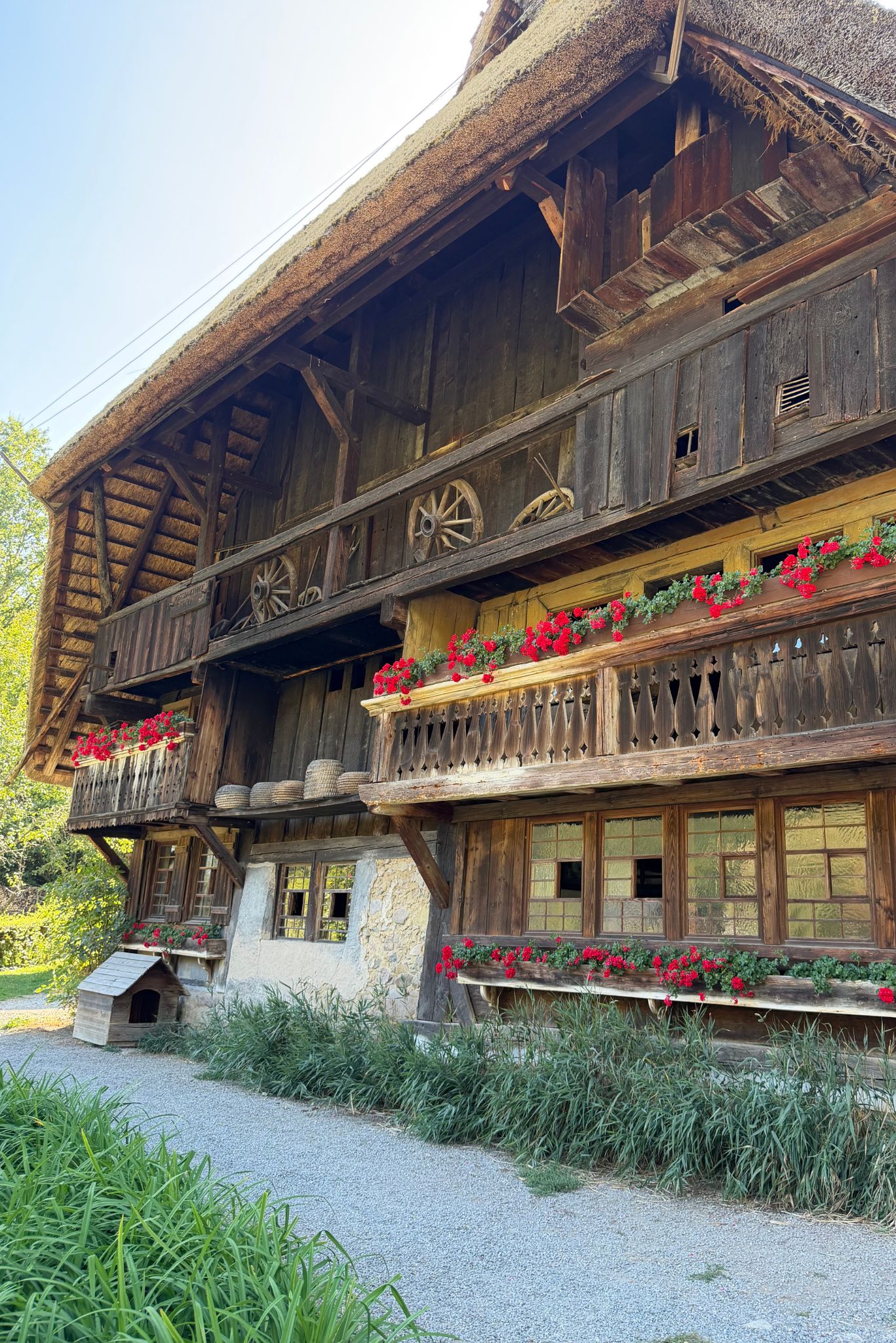
Today, while traveling along the Rhine River, I took a daylong excursion into Germany’s Black Forest. I expected beautiful scenery. I did not expect a centuries-old farmhouse to give me a lesson in business strategy.
A farmhouse built around reality
The traditional farmhouses of the Black Forest are enormous. At first glance, you might assume the families who built them simply wanted a very large home. But the house was much more than a residence. It held the family’s living quarters, the animals, food and hay storage, equipment, and working areas beneath one vast roof.
The part I found most fascinating was the upper level. Because many of these houses were built into a hillside, the farmers created a high entrance on the uphill side. A horse-drawn wagon, carriage, or winter sledge could travel directly into the attic or barn level to unload hay and supplies. Instead of carrying everything up through the building, they used the mountain as a loading dock.
Maybe the engineer in me was showing, but I thought this was exceedingly clever. The builders did not fight the terrain. They designed around it. They did not accept that the work had to be hard simply because the building had multiple levels. They put the door where the work needed to go.
They put the door where the work needed to go.
And I immediately thought about how differently many of us run our businesses.
The lesson I learned from visiting other practices
When I owned my orthodontic practice, I made it a point to travel around the country and visit other orthodontic practices outside my competitive area. I wanted to see how other owners thought, how their work moved, how their teams operated, and how they shaped the patient experience.
Every visit taught me something. Often, I would see another practice doing something I had never considered. Sometimes it was a process, a staffing decision, a way of communicating, or a completely different approach to solving a familiar problem. Those discoveries expanded what I believed was possible, and I could take the underlying idea home and adapt it to fit my own practice.
But the second lesson was even more valuable.
I would also notice that another successful practice was not doing something I had assumed every successful practice needed to do. They had eliminated a step, structured a responsibility differently, or simply refused to maintain a process I had treated as nonnegotiable—and they were still successful.
That is a very different kind of education. It does not show you what to add. It shows you what might be safe to remove.
Sometimes innovation is not finding something new to do. It is finally recognizing what you can stop doing.
Every business has inherited rooms
When you acquire a business, you do not inherit only its patients, employees, equipment, reputation, and revenue. You also inherit its assumptions. You inherit processes created by the previous owner, workarounds built for old software, policies written in response to problems that may no longer exist, and routines nobody remembers choosing.
Over time, the original reason disappears but the activity remains. Eventually it becomes one of those ‘this is how we have always done it’ things—a sentence that sounds like an explanation but is actually a warning.
Some inherited practices are valuable. Some protect quality, improve consistency, or make life better for the people we serve. But others remain only because no one has asked them to defend their existence. They consume time, attention, payroll, and energy without creating a meaningful benefit for the patient, the client, the team, or the business.
When we are stuck in operator mode, our instinct is often to make the process faster. We add another person, another checklist, another approval, or another layer of management. A CEO asks a more important question first: Should this process exist at all?
Notice what is missing
Most people visit another business looking for ideas they can bring home. That is useful, but it is only half the opportunity. Pay equal attention to what is absent. Notice the meeting they do not hold, the handoff they do not require, the position they do not have, or the service they do not offer—and then look at whether the desired result is still happening.
Their absence is not automatic proof that you should copy them. But it is proof that your way is not a law of physics. Once an assumption is demoted from ‘the truth’ to ‘a choice,’ you can finally evaluate it.
Start with these questions:
What outcome was this process originally designed to create?
Does it still create that outcome today?
Does the patient or client value it—or have we simply decided that she should?
What would actually break if we stopped doing it for 30 days?
Could we produce the same result with fewer steps, approvals, or handoffs?
If we were building this business today, would we deliberately design it this way?
Leave your industry, too
Looking at businesses within your field is valuable, especially when you visit those outside your competitive area. But I would go even further: look outside your space altogether.
Entire industries can share the same blind spots. When everyone has inherited similar assumptions, benchmarking only within the industry can show you the best version of a familiar approach. It may never show you a completely different approach.
A hotel may change how you think about arrival and welcome. A manufacturer may change how you see waste and workflow. A restaurant may change how you think about capacity. A logistics company may expose the cost of unnecessary handoffs. The point is not to turn an orthodontic practice into a hotel, factory, restaurant, or delivery company. The point is to borrow a new lens.
This is not about copying. It is about seeing enough possibilities that you can choose deliberately.
Find your high entrance
The Black Forest farmers could have kept carrying hay and equipment up through the farmhouse. They could have hired more hands to move the same load. Instead, they redesigned the relationship between the work and the building. They used the hill and created a high entrance.
Where in your business are you still carrying hay up three flights because nobody has questioned the location of the door?
Before you ask your team to work harder, add another person, buy another tool, or create another system, step outside your bubble. Visit other practices. Observe businesses outside your industry. Look carefully at what they do—and what they do not do. Then return to your own business with possibilities, not prescriptions.
A business-by-design is not a collection of inherited behaviors. It is a collection of deliberate choices. Every process should be able to explain whom it serves, what result it creates, and why it deserves the time it consumes.
Tradition can be beautiful. That centuries-old farmhouse proves it. But the design has endured because it solved a real problem. Your business deserves the same clarity.
Do not keep carrying the load upstairs. Put the door where the work needs to go.
Is your practice running on your decisions—or your exhaustion?
Take The Operator Trap scorecard to find out where your business is running you—and what it takes to take the crown back: dranacastilla.com/operator-trap